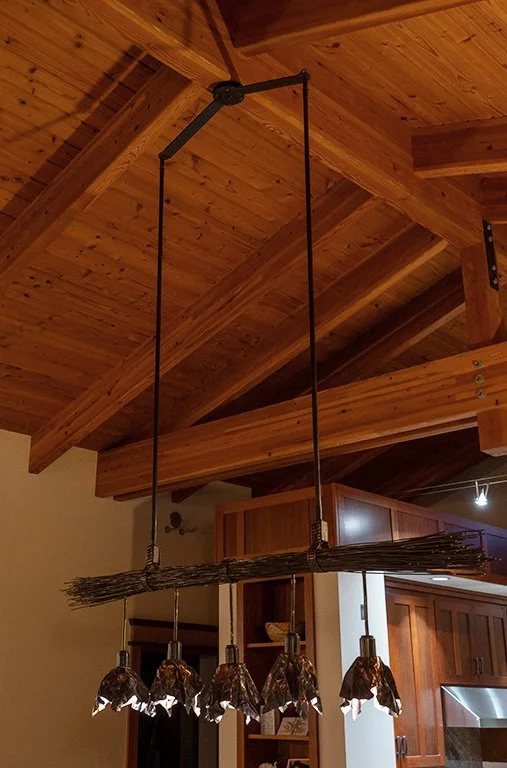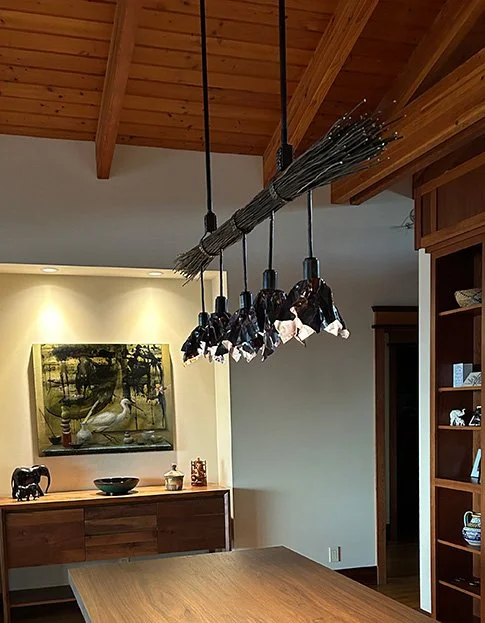
This chandelier was created for a beautiful waterfront home on Bainbridge Is., Washington. The view out the front windows was of a driftwood strewn beach on Puget Sound. I wanted the design to draw from the natural beauty surrounding the home. The drift wood was not right for this room but for some reason I remembered a Led Zeppelin album cover that featured a man with a large bundle of sticks on his back. When I mentioned it to the client they remembered the album and liked the idea of the bundle as a key part of the project. I presenting a drawing and we decided to go with the “Bundle of Sticks” idea as the catalyst for the design. After giving it some thought, I realized that actual sticks could be fragile and prone to breakage during routine cleaning and dusting. I was talking with a sculptor friend about the idea and showed him the drawing. I mentioned my hesitation about using real sticks and the idea of wire came up. He disappeared for a moment and returned with some pieces of 1/8” brass tubing that had been outside for years. They had attained a beautiful, natural, dark, weathered patina. They were great except they were only about 12” long. After seeing my excitement, he ushered me out side to show me a long, approximately 14’, x 8” diameter, bundle of that same tubing, laying under a tree in his yard. It had been there for years. He offered it to me in trade for some photography (I was a commercial photographer for 30 years) of his beautiful, cast bronze, wildlife sculptures. He delivered the bundle to my shop and the fun began.
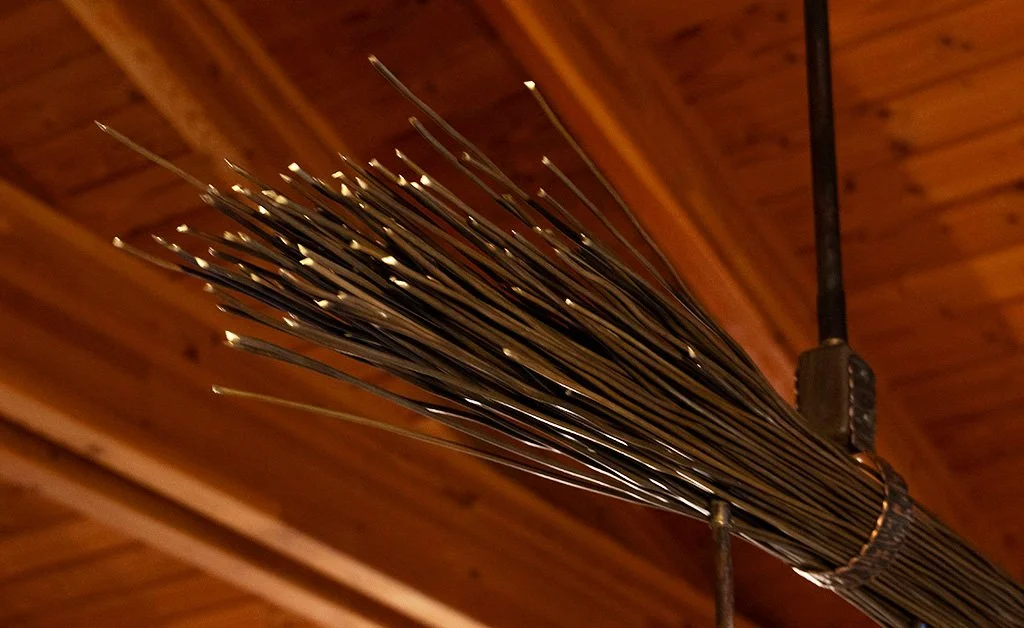
I started pulling tubes from the bundle and cutting them into lengths between 52” and 62” lengths. I made cradle and started laying them out until I reached a diameter that I thought would look good over the table. The ends were cut to look like pruning snips. The tubes were individually rubbed to remove the loose surface patina. This reveled a rich, dark bronze tone underneath. The ends were then pressed into a wire wheel to soften the cuts and add a bright, brass, tip to each “stick”. Each tube was them bent and straightened and bent and straitened until they had a more organic shape. I did this 137 times.
Two hanger collars were then created to hold the “sticks” in a loose bundle with another round collar in the center to help maintain the shape through the entire length of the bundle. These were made from hammered, copper, water heater flex tubing. A dark patina was created to make them compatible with the finish on the “sticks”. A 1’’ tube was buried in the top of the bundle to carry the wires to each hanger. From there they went up through the 1/2” copper tubes to the steel hanger bracket secured to the beam over the table. The buried tube had nuts soldered to the bottom where the copper stems and shades were attached.
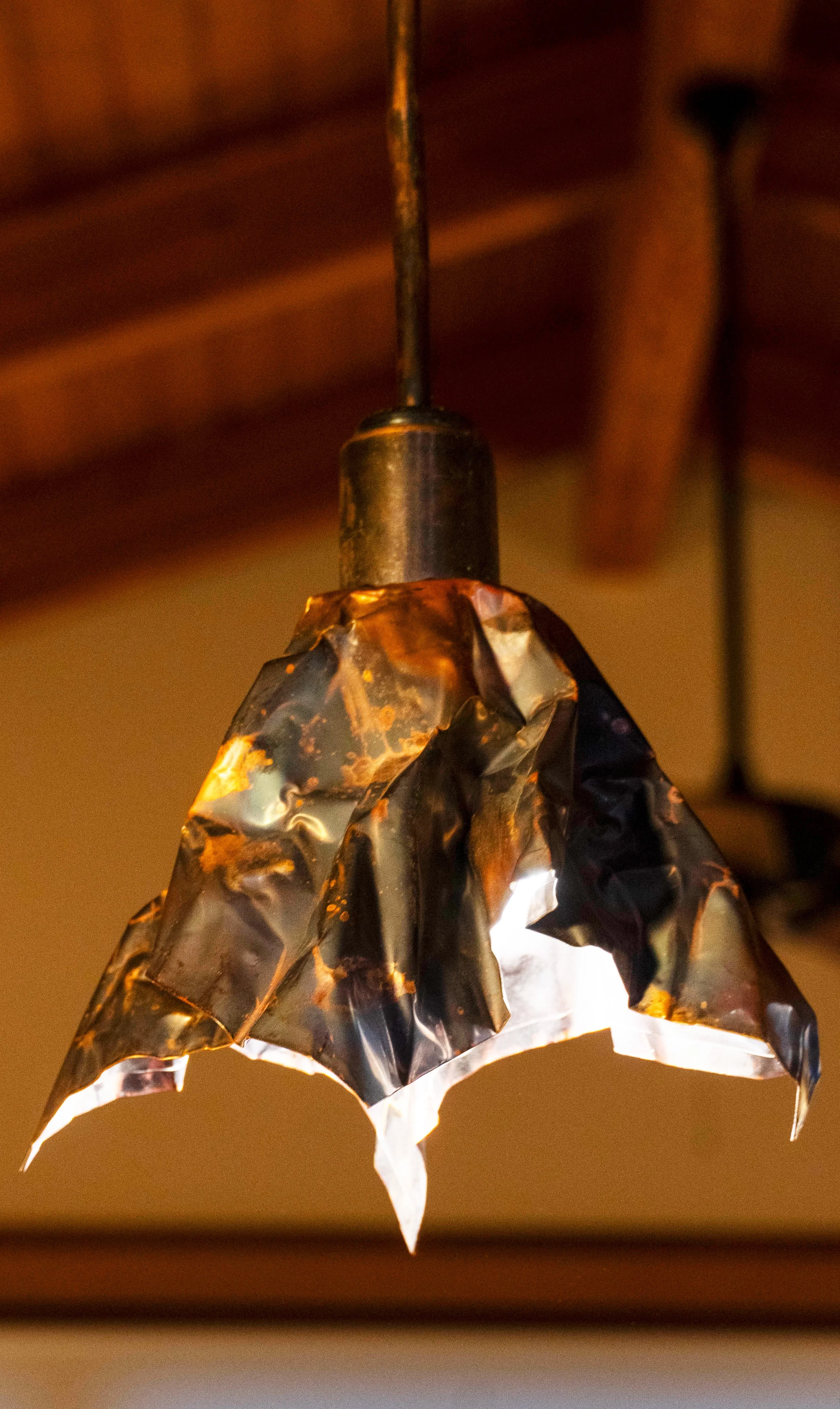
The shades were fabricated from copper foil, heated to a cherry red to make them very soft and easy to crush into the desired shapes. The heat process also created a wonderful “fire finish” on the surface of the copper. The socket cups had a Paperstone disc on top with a slightly oversize hole to allow the shades to be raised to give easy access to the bulbs for re-lamping. Each pendant had a shallow, 50w equivalent, LED flood bulb. The five bulbs gave great edge-to-edge light coverage over the table. The chandelier was hung about 8’ from the beam to the bottom of the shades. This gave and uninterrupted view of the water from the kitchen. The fixture was 62” long with a 3” bundle of tubes.